
The Future of Personal Mobility: Trends and Innovations Shaping the Next Decade
Personal mobility is entering a period of transformation. In the next decade, AI, connectivity, and human-centered design will turn mobility devices into systems that better support independence and accessibility.
From intelligent wheelchairs that adapt in real time to city-wide platforms that coordinate accessible transportation, this article explores how new technologies and social changes are improving access and redefining independence for people around the world.
Trend #1: Smart Wheelchairs and AI-Powered Navigation
Smart wheelchairs with AI navigation are shifting mobility from user-operated devices to autonomous transportation in busy environments. WHILL has made this trend accessible through self-driving wheelchairs at major European airports, including Munich Airport and Copenhagen Airport.
Autonomous wheelchairs are available to transport passengers with reduced mobility independently across terminals. These units use various technologies to navigate crowded spaces without manual control, such as:
- Mapping capabilities
- Obstacle avoidance systems
- Sensor fusion
These smart wheelchair innovations are ideal for navigating busy environments, detecting obstacles, adjusting speed, tracking battery life, and monitoring conditions in real time. WHILL’s autonomous service shows how artificial intelligence can extend independence while supporting large-scale commercial operations in real-world settings.
Trend #2: Next-Gen Battery Technology and Charging
Current battery technology innovation prioritizes safety and daily usability over extreme range. Manufacturers continue to refine lithium-ion systems while monitoring emerging options, such as graphene batteries.
Graphene batteries remain experimental and aren’t used in mobility scooters or commercial electric wheelchairs. Some electric vehicles use graphene-enhanced lithium-ion batteries, but mobility devices don’t yet. Early pilots in labs, drones, and e-bikes are promising, but widespread use is still years away.
Wireless charging mobility systems let users park devices on a mat for automatic charging, reducing cables and increasing independence. Most current systems use inductive charging mats for short-range, aligned charging, aiming to simplify daily recharging rather than increase speed or range.
Smarter battery management will integrate with wireless charging to automate power flow and adjust charging to usage patterns. As wireless charging mobility matures, the focus will remain on safer charging and more predictable performance rather than unproven range gains.
Trend #3: Mobility as a Service (MaaS) Platforms
Mobility as a Service (MaaS) platforms are evolving to handle accessibility as structured data, not a manual add-on. Systems may soon use real time mapping, accessibility tags, and predictive routing to plan trips that account for step-free paths and compatible vehicles.
Many cities are expected to adopt subscription-based transportation models within MaaS. These plans may bundle public transit and on-demand rides under one account. Unified payments and saved preferences will reduce the need for repeat setup across trips.
Private companies are also providing mobility services in cities, such as Bird’s easy mobility rental service, which paired with WHILL to provide rental wheelchairs and other electric vehicles.
Shared mobility platforms will exchange accessibility data, enabling consistent, tailored routing across public and on-demand services. Integrated transport solutions combine routing, booking, and live assistance for easier wheelchair journeys.
Trend #4: Voice Control and Hands-Free Navigation
Voice control now goes beyond basic commands to more adaptive mobility systems. Future voice-activated assistive technology is expected to support more reliable speech recognition in busy or echo-filled environments. This shift enables a voice-controlled wheelchair to respond to natural phrases for controlling movement, adjusting speed, and selecting modes.
Hands-free mobility is expanding through the combination of voice input, smart glasses using eye tracking, sensors, and software that assists with navigation while maintaining manual override availability. Systems are projected to learn routine paths and adjust in real time. Smart home mobility integration will let devices interact with doors and lighting for smoother movement.
Trend #5: Wearable Exoskeletons for Enhanced Mobility
Wearable exoskeleton technology is advancing toward systems that support standing and controlled walking with greater stability. New powered exoskeletons emphasize lighter frames, improved balance, and smoother assistance at the hips and knees. Embedded software adapts support in real time based on posture and movement patterns.
These gains build on progress in rehabilitation robotics, where AI-driven gait modeling refines gait and reduces energy demand. This contributes to human augmentation mobility by enhancing natural motion rather than imposing rigid mechanics.
Assistive exoskeleton devices are moving beyond clinics to structured training and daily use, under clear safety protocols.
Trend #6: Modular and Adaptable Designs
Some mobility chairs now feature modular components for customization and longevity. This lets users customize style and swap parts like seats, controls, or batteries as their needs change. This approach allows a mobility chair to be adapted over time, for comfort, driving preference, or even to add new capabilities. Modularity also simplifies repairs. Removable parts can be serviced or replaced without lengthy downtime, allowing users to get back to being mobile faster when something breaks or wears out.
As this trend grows, manufacturers are focusing on standardized interfaces and tool-free adjustments, giving users and technicians more flexibility.
Trend #7: Adaptive Seating and Ergonomic Design
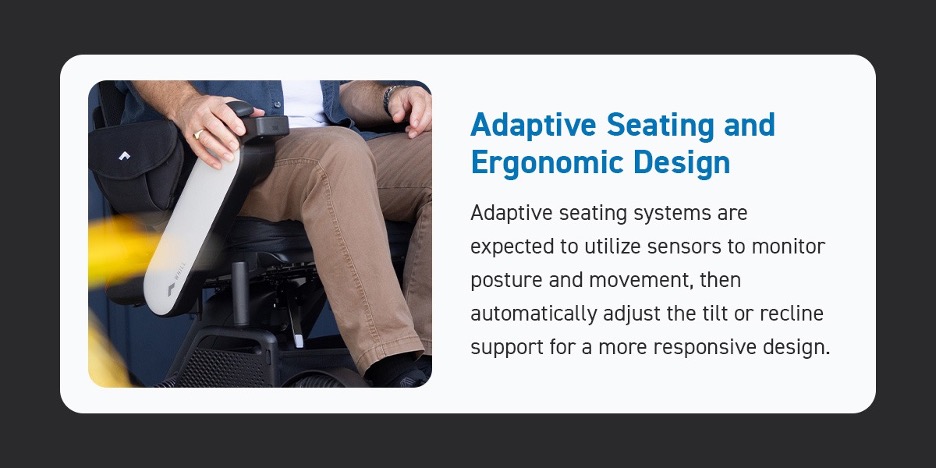
Adaptive seating systems are expected to utilize sensors to monitor posture and movement, then automatically adjust the tilt or recline support for a more responsive design. Ergonomic wheelchair design continues to advance through modular components and intelligent controls. Adjustable back rests, lumbar supports, and pressure-redistribution cushions allow seating to adapt throughout the day.
With power tilt and elevation, these custom seating designs help improve circulation and reach.
Trend #8: Solar Power Integration
Solar power is emerging as a supplemental feature in electric mobility technology, focusing on extended usability rather than replacing standard charging. Small, panel-based systems can be integrated into accessories such as canopies or external mounts, providing low-level power during outdoor use.
This input doesn’t fully recharge a chair, but it can help slow battery depletion on long days away from power outlets. This supports activities like extended outings or outdoor events where charging access is limited and carrying an extra battery is impractical. Manufacturers are working to develop simpler solar connection solutions that minimize added weight.
As this trend develops, solar power could be positioned as a reliable backup, not a main energy source.
| Trend | Core Innovation | Primary Benefit | Projected Impact (Next 10 Years) |
|---|---|---|---|
| AI Navigation | Autonomous routing & obstacle detection | Reduced cognitive load & safer navigation | Increased independence in large public environments |
| Advanced Batteries | Smarter lithium-ion & wireless charging | Safer, simpler daily charging | More reliable performance & convenience |
| MaaS Integration | Accessible routing & unified transport platforms | Seamless multimodal journeys | Fully connected urban accessibility ecosystems |
| Voice & Hands-Free Control | Natural language & sensor integration | Improved ease of use | Expanded mobility access for varied abilities |
| Wearable Exoskeletons | AI-assisted powered support | Enhanced standing & walking assistance | Hybrid mobility solutions |
| Modular Design | Interchangeable components | Customization & easier repairs | Longer product lifespan & flexibility |
| Adaptive Seating | Sensor-driven ergonomic adjustments | Improved comfort & circulation | Reduced fatigue & better health outcomes |
| Solar Integration | Supplemental panel charging | Extended outdoor usability | Greater energy resilience |
How These Trends Work Together
Shared data and infrastructure let mobility systems work as connected networks, not isolated tools. Here’s how these technologies connect and what we can expect in the future of urban mobility.
- Autonomous wheelchairs integrating with MaaS platforms: Autonomous wheelchairs share location and access data with MaaS systems, enabling coordinated routing across transit and on-demand services.
- Wearable technology enhancing physical mobility: Wearables provide movement and health data that support adaptive assistance and smoother transitions between mobility modes.
- Smart infrastructure supporting real-time navigation: Connected hubs supply live information that allows routes to adjust dynamically around obstacles, saving time and improving efficiency.
- Universal design principles guiding development: Shared standards for controls and data allow devices and services to work together without custom configuration.
- Inclusive mobility design serving users of all abilities: Unified accessibility data enables mobility systems to adapt automatically across different environments and needs.
A More Accessible, Sustainable Future
The future of accessible transportation is being shaped by technology that responds to individual needs rather than forcing standardized use. Over the next decade, progress will be defined by whether mobility systems support independence in everyday environments.
These changes are already happening. Many of the technologies discussed are in active development, not just distant concepts. As mobility devices connect more directly with routing systems and urban infrastructure, micro-mobility solutions for cities become practical extensions of daily travel.
Mobility is moving toward an experience that adapts in real time, respects personal context, and embeds inclusion in the system itself. WHILL’s line of power wheelchairs is a step into the future of technology. With app-based controls, adjustable performance settings, and built-in system intelligence, each model supports real-world use while improving comfort and independence. Find a retailer near you today and see what the future holds.
Linked sources:
- https://whill.inc/us/autonomous-service/
- https://www.sciencedirect.com/science/article/abs/pii/S030626192500296X
- https://whill.inc/us/mobility-scooter-speed-everything-you-need-to-know/
- https://www.researchgate.net/publication/398340470_Graphene_battery_as_a_viable_alternative_in_electric_vehicles_for_enhanced_charging_efficiency_and_thermal_management
- https://whill.inc/us/bird-launches-accessible-rentals-pilot-program-in-nyc/
- https://pubmed.ncbi.nlm.nih.gov/40824827/
- https://whill.inc/us/not-just-a-chair-its-a-statement-how-customization-reflects-your-personality/
- https://whill.inc/us/ride-in-style-whills-stylish-mobility-devices-accessories/
- https://whill.inc/us/the-evolution-of-wheelchair-technology/
- https://whill.inc/us/find-a-store/