When you picture your ideal power chair, do you picture the chair itself, or the freedom it gives you to live without limits? Chances are, it’s the latter. You don’t want to worry about its reliability. If you’re considering investing in a new power chair, it’s essential to understand how its battery works, as this will allow you to make a sounder investment in your mobility and freedom.
This blog is your guide to power chair batteries. We’ll discuss the technology behind electric wheelchair batteries, how long they last, and how to maximize their lifespan.
How Long Does a Battery in a Power Chair Last?
A fully charged power chair can provide about 8 hours of use or roughly 10 to 15 miles of travel. However, the battery life of a mobility chair depends on various factors and also varies by manufacturer. When investing in a new power chair, choose one tailored to your lifestyle from a reliable manufacturer.
Different Types of Power Chair Batteries
There are two main types of power chair batteries.
Sealed Lead-Acid Batteries
Sealed lead-acid (SLA) batteries are a traditional option for power chair batteries. They use a chemical reaction between lead plates and an electrolyte to store and release energy. An SLA battery offers a steady amount of power but loses efficiency as it drains.
SLA power chair batteries have the following features:
- Charging: They tend to be slow to fully charge. It’s important to fully recharge them after each use, as partial charging can potentially shorten their lifespan.
- Cost: SLA batteries have a lower initial cost.
- Energy density: These batteries tend to be larger and heavier as they have a lower energy density.
- Lifespan: The typical lifespan of SLA batteries ranges between one and three years.
- Maintenance: SLA batteries require more regular maintenance. They also need careful charging habits, as they can be more sensitive to misuse.
- Performance: As the day goes by, its performance can drop more quickly.
- Safety: These types are considered safe. They are more stable and less sensitive to extreme temperatures.
- Weight: SLA batteries can be on the heavier side, especially when compared to lithium-ion batteries.
Lithium-Ion Batteries
Lithium-ion (Li-ion) wheelchair batteries are the more modern and advanced option. The way they store energy is by moving lithium ions between a positive and a negative electrode. Compared to SLA batteries, Li-ion batteries offer more consistent performance all the way up until they’re almost completely discharged.
The features of Li-ion power chair batteries include:
- Charging: Li-ion batteries have much faster charging capabilities. They also tolerate partial charges better, which makes quick top-ups less of a worry.
- Cost: While higher in up front costs, they offer more long-term value. Their lifespan is longer, so you get value for your investment, and save money from lower maintenance needs.
- Energy density: Li-ion batteries have a much higher energy density than SLA batteries. This means they can store more energy in a smaller space.
- Lifespan: Their lifespan tends to be longer than their alternatives. Li-ion batteries may last between three and five years, potentially longer.
- Maintenance: The maintenance requirements for these batteries are practically effortless. They need less attention than their SLA counterparts.
- Performance: Unlike SLA batteries, the performance of Li-ion batteries does not weaken as the day progresses. Mobility chairs can perform more consistently.
- Safety: Most modern Li-ion batteries include a battery management system. They’re designed to prevent issues like overheating or overcharging. However, lithium batteries can be more sensitive to temperature changes.
- Weight: Li-ion batteries are significantly lighter in comparison to SLA batteries, which can help with maneuverability.
Why a Better Battery Is a Smarter Investment
When you buy a new power chair, there is more to consider than just its initial purchase price. There’s also the total cost of ownership (TCO) that can impact your user experience and long-term finances.
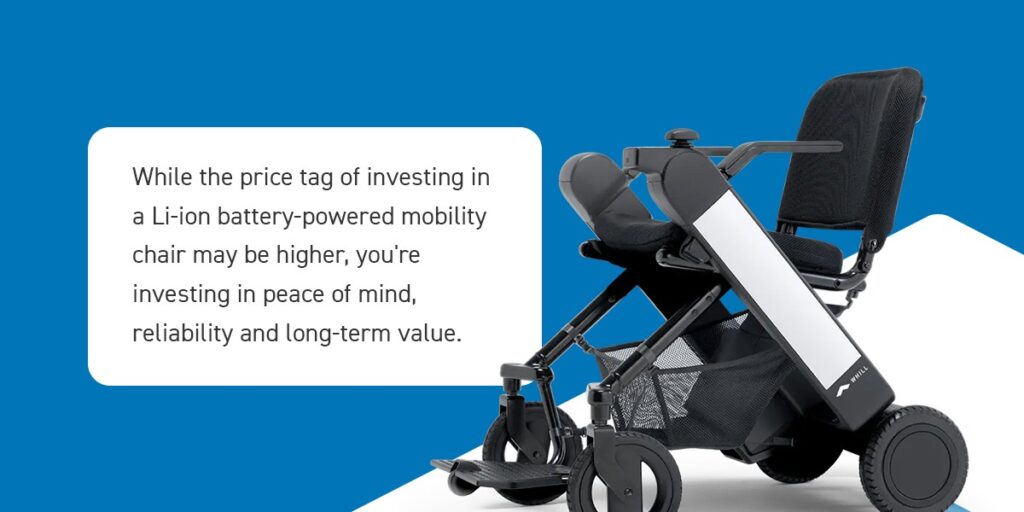
While it may be tempting to buy a chair with a cheaper SLA battery, its replacement frequency and maintenance needs may be more demanding. Investing in a Li-ion battery-powered mobility chair can have the opposite effect. While its price tag may be higher, you’re investing in peace of mind, reliability, and long-term value. There are fewer ongoing expenses to maintain a better battery’s performance and lifespan.
Factors That Influence Battery Lifespan
On average, mobility chair batteries can last anywhere between one and five years. While the battery type plays a role, the lifespan of a power chair battery depends on several factors, including:
- Charging habits: How you charge the battery is a big determinant. Undercharging and overcharging may impact the battery’s health over time. Also, if you leave the battery drained for long periods, it may stress the cells. And constantly topping it up without giving it rest may also cause wear.
- Depth of discharge: This refers to the extent to which you run down the battery. If you let them drop too low too often, their lifespan is shortened. That’s because deep discharges strain the cells.
- Temperature exposure: Extreme temperatures can shorten its lifespan. Heat speeds up the chemical breakdown and the cold can reduce its efficiency.
- Weight load: Heavier loads can strain the battery. The motor will have to work harder, which uses more energy, which also depletes the battery faster. With constant extra effort, there may be accelerated wear.
- Terrain type: If the terrain requires more battery power, it can negatively impact the battery. Such terrain would include inclines and navigating through tough outdoor terrains and obstacles.
- Usage frequency: Batteries have a limited number of charge cycles. This means that daily heavy use naturally burns through cycles more quickly — and even when not in use, batteries can age over time.
- Driving behavior: When wheelchairs have to frequently start and stop, or are driven at high speeds frequently, it requires more power. This stress shortens the battery’s lifespan.
How to Maximize Your Power Chair’s Battery Life
There are several best practices that may help extend the battery life of a power chair, including:
- Follow a smart charging routine: Charge your chair’s battery at consistent times, regularly. Prevent it from dropping too low. Also, try not to leave it unplugged for extended periods, as this can fully deplete the battery. Another best practice is using the charger provided with your unit.
- Store it at room temperature: Store and charge your power chair’s battery somewhere in a temperature-controlled environment. A moderate climate can help keep the internal chemistry stable.
- Reduce unnecessary weight: Avoid adding extra weight to your chair. You can remove items you don’t need, such as extra bags or heavy accessories. Keep the weight load within the manufacturer’s recommended range.
- Use efficient driving habits: Practice smarter driving habits like maintaining a consistent speed instead of doing quick bursts of acceleration. Try not to unnecessarily start and stop too frequently. You can also choose smoother terrain to avoid straining the battery.
- Maintain your mobility chair: Have an easy-to-follow maintenance plan. This could include checking and keeping your battery terminals clean to prevent corrosion. If required, remember to maintain proper tire pressure.

Experience Uninterrupted Freedom With WHILL
You now understand the technology and the factors that go into a truly reliable power chair. Choosing WHILL is an investment in reliability and longevity. Our power mobility chairs use advanced, high-density lithium-ion cells, developed in partnership with a world-leading manufacturer.
With us, you get a battery that’s powerful, compact, lightweight, long-lasting, and Federal Aviation Administration (FAA) compliant. Their five-hour charge time means your chair is ready to go when you are, and not the other way around. They’re also swappable, giving you peace of mind that you can navigate a full day of errands and social visits without checking your battery meter.
Reading about the WHILL difference is one thing. Feeling it is another. We personally invite you to schedule a no-obligation test-drive at your closest retailer to experience the seamless power and quiet confidence our chairs provide.
Linked Sources: